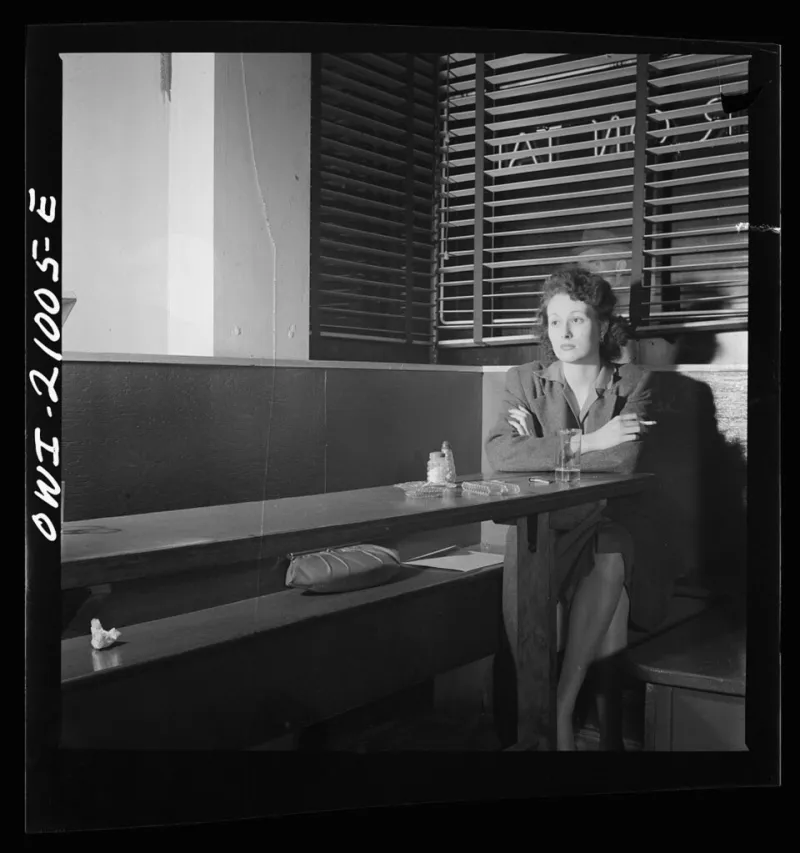
Proof of Presence: How the Need to Show You Were There Is Quietly Killing the Thing You Went to See
Photo: GDK98, CC0, via Wikimedia Commons
There's a particular magic that lives inside spaces that aren't supposed to exist. The basement show with a hand-painted address on a flyer. The supper club where you got in through a friend of a friend and the menu changed three times before you sat down. The collector meetup held in someone's garage where a 1972 pressing changed hands for cash and nobody asked questions. These spaces work because they're invisible. The invisibility is the point.
So what happens when everyone in the room is quietly, compulsively making them visible?
The Phone Came In With You
It didn't used to be like this. Ask anyone who came up through underground music scenes in the early 2000s and they'll tell you: you were either there or you weren't, and the distinction mattered. The experience lived in memory, in conversation, in the specific texture of having been inside something that most people never got to touch. The underground operated on scarcity — not of tickets or access necessarily, but of record. There was no footage. There was no grid post. There was just the thing itself.
Now there's footage. There's always footage.
The shift didn't happen overnight, and it wasn't malicious. It started with good intentions — preserving a set from a band that broke up six months later, documenting a space before it got shut down by the city, sharing something genuinely beautiful with people who couldn't make it. Documentation as love letter. But somewhere along the way, the love letter became a press release, and the press release became a performance, and the performance became the whole point.
The Collector Problem
Closed collector communities have been wrestling with this longer than most. Vintage sneaker circles, rare vinyl networks, antique toy collectors who meet in church basements in the midwest — these groups built their entire culture around the idea that the knowledge was the currency. You knew things. You'd seen things. Your credibility came from years of quiet accumulation, not from a highlight reel.
Then came the era of the unboxing video, the haul post, the "look what I just scored" Instagram story. Suddenly the acquisition mattered less than the announcement of the acquisition. Collectors started noticing something uncomfortable: newer members seemed less interested in the objects themselves than in the social capital generated by displaying them. The community hadn't changed its rules, but the incentive structure around it had shifted completely.
One longtime member of a closed vintage toy forum put it bluntly in a thread that got a lot of traction a couple years back: "We used to talk about the stuff. Now half the posts are people talking about talking about the stuff." The meta-layer had eaten the layer underneath it.
Underground Venues and the Visibility Trap
The stakes get higher when you're talking about physical spaces that depend on obscurity for their survival. Underground music venues — the ones operating in legal gray zones, the ones that don't have liquor licenses or fire code compliance — have always relied on a kind of community-enforced silence. You told the right people. You didn't tell the wrong ones. The address stayed off the internet.
That social contract is getting harder to maintain. Not because people are deliberately blowing spots, but because the reflex to document has become so automatic that it bypasses the old judgment calls entirely. Someone posts a Story without thinking. Someone tags a location out of habit. Someone's background footage includes a street sign, and now the address is findable if you know what to look for.
But beyond the practical risk, there's a subtler transformation happening inside these spaces. When documentation becomes normalized, the experience starts to reorganize itself around the camera. People position themselves differently. Performers play to phones as much as to the room. The energy shifts from inward — we are all here, inside this thing together — to outward, toward an imagined audience that isn't present. The underground show starts to feel, just slightly, like a content shoot.
Secret Supper Clubs and the Aestheticization of Exclusivity
Secret supper clubs have perhaps the most complicated relationship with this dynamic, because their appeal was always partly aesthetic to begin with. The mystery address, the unmarked door, the handwritten menu — these weren't just logistical choices, they were atmosphere. They were the meal before the meal.
The problem is that atmosphere photographs beautifully. And once something photographs beautifully, the pressure to photograph it becomes almost structural. Supper club organizers across the country have started reporting the same phenomenon: guests arrive and immediately spend the first fifteen minutes shooting the table, the lighting, the food before it gets touched. The experience is being pre-consumed through the lens before it's actually consumed in person. Some hosts have started explicitly asking guests not to post until 24 hours after the event. Others have gone further, requiring phones to be left in a basket at the door.
Both solutions create their own friction. The no-phone rule feels controlling to some guests. The delayed-posting rule still produces content; it just delays the broadcast. Neither actually addresses the underlying tension, which is that the supper club's value now exists in two places simultaneously: in the room, and in the proof that you were in the room.
Being There vs. Showing You Were There
Here's the paradox at the center of all of this: the documentation that's meant to honor underground spaces is the same force that's hollowing them out. The more you prove you were there, the more "there" becomes a set rather than a sanctuary. Visibility is the underground's most valuable resource and its most dangerous liability at the same time.
This isn't really about phones, and it's not really about social media platforms, even though both are convenient villains. It's about a deeper shift in how we've come to understand experience itself — as something that needs external validation to fully exist. If you went to the show and didn't post about it, were you really at the show? The question sounds absurd, but a lot of people are quietly asking it.
The underground was built on the radical premise that some things are worth having without the receipt. That the experience doesn't need a witness beyond the people already in the room. That scarcity of record is what gives certain moments their specific gravity.
The communities still trying to hold that line aren't being precious or paranoid. They're trying to protect something real: the difference between living inside a thing and performing your relationship to it. Those aren't the same experience, even when they look identical from the outside.
And right now, from the outside, they're starting to look very identical indeed.