Living in a Different World: How Niche Aesthetics Became Our Most Honest Form of Self-Expression
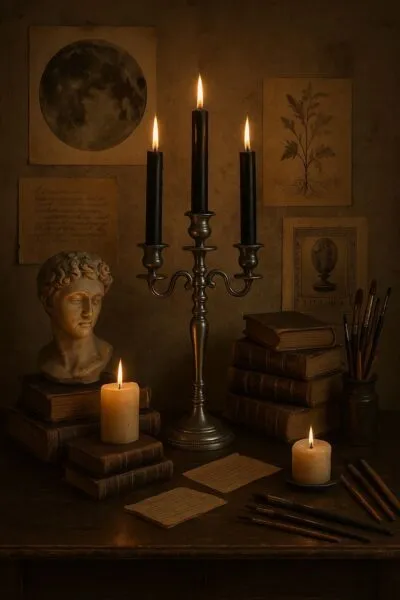
Photo: cozy dark academia aesthetic candles books vintage study room, via skyryedesign.com
There's a particular kind of rabbit hole you fall into at 2am on a Tuesday. Maybe it starts with a video of someone arranging dried flowers on a wooden table, soft candlelight, a dog-eared copy of Wuthering Heights just barely in frame. Before you know it, you've watched forty-seven videos, you're pinning linen aprons to a secret board, and you're genuinely wondering if you could learn to make sourdough and move somewhere with a lot of fog.
Welcome to the aesthetics. Population: everyone who's quietly exhausted by the actual world.
More Than a Mood Board
Cottagecore, Dark Academia, Goblincore, Royalcore, Weirdcore — the list keeps expanding, and each one feels less like a trend and more like a whole philosophical stance on how life should feel. These aren't just visual styles people slap on their Instagram feeds. They're complete sensory universes with their own music playlists, reading lists, fashion codes, and emotional registers.
And people aren't just consuming them — they're inhabiting them.
Dark Academia, for example, isn't really about tweed blazers and candlelit libraries (though, yes, those too). At its core, it's a community built around the romantic idea of intellectual obsession — the feeling that learning something deeply and desperately matters. For a generation that was handed student debt and a gig economy, the fantasy of wandering ivy-covered hallways with nothing to do but read Greek philosophy hits different.
Cottagecore, meanwhile, is basically the aesthetic equivalent of logging off forever. It's the dream of a slower, quieter life — baking bread, foraging mushrooms, existing in soft morning light without a single push notification. The pandemic accelerated its rise dramatically, but the longing it taps into is older and deeper than COVID lockdowns.
The Psychology of the Alternate Self
So what's actually going on here? Why are people — particularly Gen Z and younger millennials — so drawn to building entire identities around hyper-specific visual and emotional worlds?
Part of it is straightforward escapism, and there's nothing wrong with calling it that. Life in the US right now is genuinely a lot. The news cycle is relentless, housing costs are absurd, and the algorithm is always one bad scroll away from ruining your afternoon. Of course people are going to reach for something that feels like a different reality.
But there's something more interesting happening underneath the escapism. These aesthetics aren't passive fantasies — they're participatory. You don't just watch cottagecore videos; you style your room, you thrift the cardigan, you start a journal. You become a contributor to a shared visual and emotional language. That's community-building, just dressed up in forest linen.
Disocrd servers dedicated to specific aesthetics can get remarkably granular — there are entire channels debating whether a particular book qualifies as Dark Academia enough, or which mushroom varieties are most goblincore. It sounds absurd from the outside, but that level of specificity is exactly the point. It creates genuine belonging. You're not just into "vintage stuff" — you're this kind of person, and here are eleven thousand other people who are exactly this kind of person too.
The Mainstream Problem
There's a tension that every one of these communities eventually runs into, and it's a familiar one: what happens when the niche goes mainstream?
Cottagecore had a genuine moment of going viral — it ended up on runways, in Target marketing campaigns, in think pieces on major media sites. And a lot of the people who'd been quietly building their aesthetic identities inside it felt something deflate. When Hot Topic starts selling it, the sanctuary quality disappears a little.
This is why the aesthetics keep fracturing and multiplying. When one gets too big, a splinter community forms that's even more specific, even harder to casually claim. Goblincore emerged partly as a weirder, dirtier, less palatable cousin to cottagecore — moss and bones and found objects instead of linen and lavender. It's almost like an immune response to mainstream co-option.
The smaller and stranger the aesthetic, the more it functions as a genuine identity marker rather than a product category.
Curating an Alternate Life
There's something genuinely moving about what these communities represent, when you sit with it. Most people don't get to choose a lot about the world they live in. You can't opt out of late-stage capitalism or decide the news is just going to be chill for a while. But you can decide what your corner of the internet looks like, what kind of person you're performing as, what emotional world you want to spend your mental energy in.
These aesthetics are, at their best, acts of imaginative self-determination. They're saying: this is the world I want to live in, even if I have to build it out of Pinterest boards and thrift store finds and Discord servers with slow mode turned on.
Is it a little melancholy that we need alternate worlds this badly? Maybe. But humans have always needed myth, ritual, and shared fantasy. We've always built small sacred spaces inside the larger chaos. The aesthetics are just the current version — and honestly, some of them have remarkably good taste.
The velvet rabbit, after all, knows something about the appeal of a hidden, beautiful world just slightly out of step with the ordinary one. Sometimes the most honest thing you can do is admit you'd rather be somewhere else — and then find the people who feel exactly the same way.